
These flour tortillas come out soft, flexible, and lightly chewy, with toasted spots and enough strength to hold juicy fillings without cracking. A moderate amount of fat, hot water, and a very hot dry skillet are the big texture levers here: they help the dough stay supple and encourage quick spotting instead of slow drying.
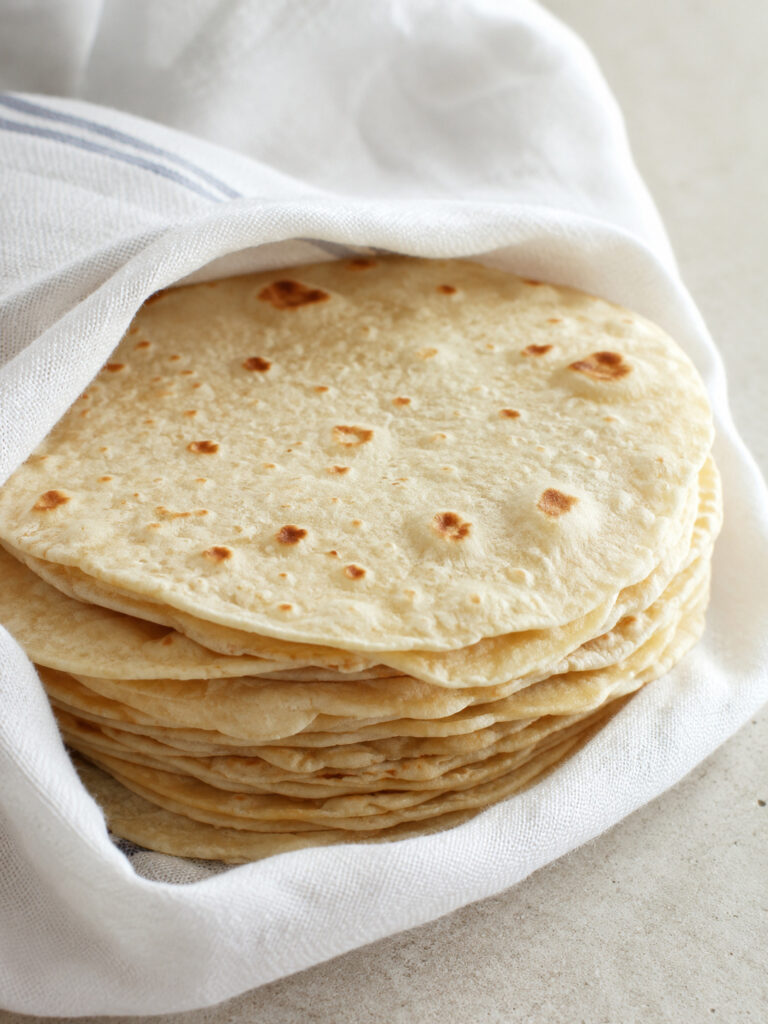
A really good flour tortilla has a very specific feel. It bends easily, folds without splitting, and tears with a soft layered pull instead of a dry snap. This version lands in that sweet spot. The flavor is simple in the best way: warm wheat, a little salt, and the rounded richness that makes beans, eggs, grilled meat, melted cheese, and roasted vegetables taste even better. The outside carries tawny freckles and light blistering, while the center stays tender and smooth.
These tortillas belong on a breakfast table, next to a bowl of charro beans, around a taco spread, or stacked in a towel for dinner all week. What makes them so loved is balance. There is enough fat for softness, enough hydration for stretch, and enough direct heat for a little steam-built lift between the layers. Even when a tortilla does not balloon dramatically, it can still be exactly right: soft, pliable, and easy to wrap. That forgiving texture is part of the appeal in a home kitchen, where dependable tenderness matters more than perfect circles.
What to Serve With: These are excellent with scrambled eggs and potatoes, carne asada, chicken tinga, refried beans, or simply butter and a spoonful of salsa. They also work beautifully for quesadillas, breakfast tacos, and wraps with grilled vegetables and cheese.
Table of contents
Flour Tortillas Ingredients
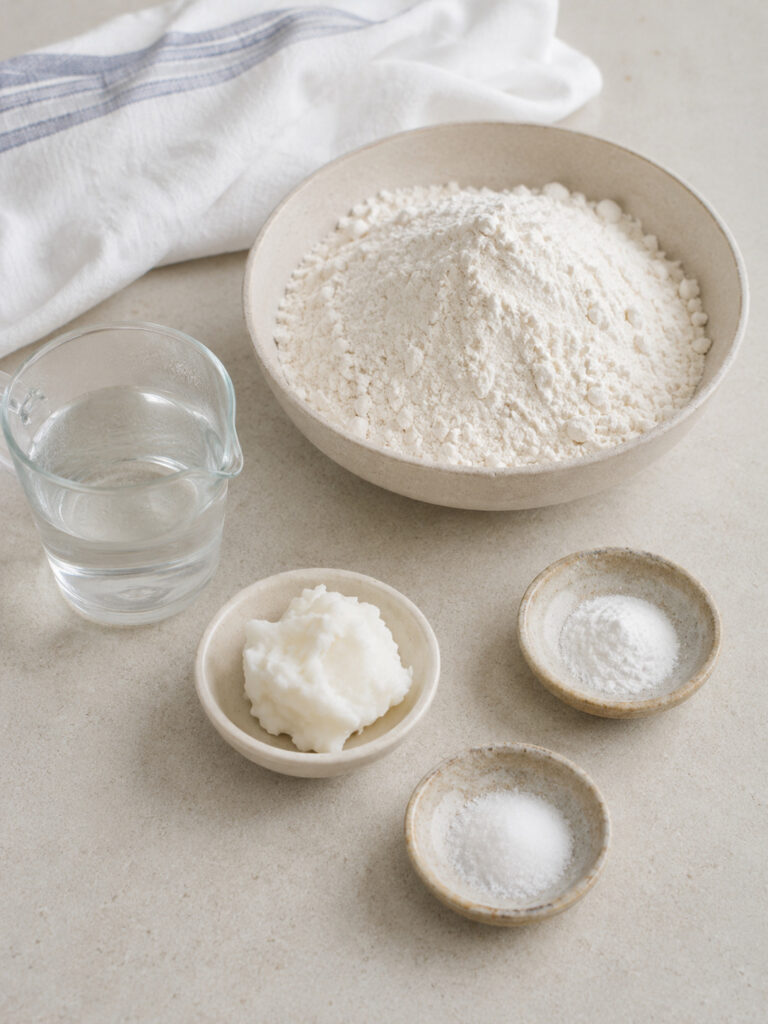
All-purpose flour – Standard all-purpose flour gives you the easiest balance of stretch and tenderness. Pastry-style flour turns out a little more delicate, while bread flour gives a springier chew. In the finished tortilla, the flour choice changes both the bite and how easily the dough rolls thin.
Lard – Lard gives the most classic flavor and the softest, most flexible texture. Vegetable shortening is milder and very tender, while neutral oil works but tastes a bit leaner and less rich. In the finished tortilla, the difference shows up mostly in aroma, softness, and that faint layered feel.
Hot water – Water around 110°F to 120°F / 43°C to 49°C helps the dough come together smoothly and hydrate quickly. That matters because a well-hydrated dough rolls thinner with less snap-back and stays more supple on the pan. In the finished tortilla, good hydration supports softness and better puffing.
Baking powder – Some flour tortillas skip it, but a small amount makes a slightly lighter, softer tortilla in a home kitchen. Without it, the tortillas stay flatter and a bit chewier. The difference is subtle, though you’ll notice it more in thicker tortillas.
Flour Tortillas Variations
- Butter tortillas (Richer and more buttery)
Change: Replace the lard with 4 tbsp / 57 g unsalted butter. Keep the water the same.
Result: A softer buttery aroma and a slightly less savory, less classic finish. The tortillas stay tender, though they are a little less richly rounded than lard-based ones. - Shortening tortillas (Very soft and neutral)
Change: Replace the lard with ¼ cup / 48 g vegetable shortening. Keep the rest of the recipe the same.
Result: Extra-soft, flexible tortillas with a cleaner, more neutral flavor that lets bold fillings stand out. - Unleavened tortillas (Flatter and chewier)
Change: Omit the 1 tsp / 4 g baking powder. Start with ¾ cup / 180 ml hot water and add only as needed.
Result: A thinner, slightly chewier tortilla with less lift and a more understated flat profile. This version is especially nice for wraps and burritos.
Storage
Fridge – Cool completely, stack well wrapped, and refrigerate up to 3 to 5 days. Keep your refrigerator at 40°F / 4°C or below.
Freezer – Freeze tightly wrapped, with parchment between tortillas if you like, for up to 3 months for best texture. Keep the freezer at 0°F / -18°C or below.
Reheat – Warm on a dry skillet over medium heat for 15 to 30 seconds per side, or wrap a small stack in a towel and microwave briefly until soft.
Allergens & Substitutions
Contains: wheat(gluten)
Flour: Use all-purpose flour for the most reliable softness. Bread flour works at the same weight for a chewier tortilla. A gluten-free 1:1 swap needs a dedicated formula, so it is not a dependable plug-in here.
Lard: Vegetable shortening works at ¼ cup / 48 g with very similar tenderness. Neutral oil works at ¼ cup / 50 ml, but the dough feels a little looser and the tortillas are less rich.
Baking powder: You can omit it for a flatter, slightly chewier tortilla. Start with less water first and add only as needed.
Soft Flour Tortillas
- Total Time: 28 min
- Yield: 8 tortillas
Description
These flour tortillas come out soft, flexible, and lightly chewy, with toasted spots and enough strength to hold juicy fillings without cracking. A moderate amount of fat, hot water, and a very hot dry skillet are the big texture levers here: they help the dough stay supple and encourage quick spotting instead of slow drying.
Ingredients
🥣 Dry Base
- 2 ½ cups / 300 g – all-purpose flour
- 1 tsp / 4 g – baking powder
- 1 tsp / 6 g – fine salt
🧈 Fat & Water
- ¼ cup / 57 g – lard (or vegetable shortening)
- ⅞ cup / 210 ml – hot water, about 110°F to 120°F / 43°C to 49°C
Instructions
Make the dough
- In a mixing bowl, whisk together the flour, baking powder, and salt.
- Add the lard and rub it into the flour with your fingertips until no visible lumps remain and the mixture feels evenly sandy.
- Pour in ¾ cup / 180 ml of the hot water and stir with a fork until shaggy. Add the remaining water a little at a time until no dry flour remains. Knead 2 to 3 minutes, until the dough is smooth, soft, and only lightly tacky. If it feels stiff or the edges crack, knead in 1 tsp / 5 ml more water at a time.
Rest and portion
- Divide the dough into 8 equal pieces, about 70 g each. Shape into smooth balls and flatten each one lightly into a puck.
- Cover and rest for 30 minutes so the flour fully hydrates and the dough relaxes. If it later springs back while rolling, give it another 10 minutes. During the rest, preheat a dry cast-iron skillet or comal over medium-high heat to about 400°F / 205°C.
Roll and cook
- On a lightly floured surface, roll one dough piece into a 7- to 8-inch / 18- to 20-cm round, turning it often so it stays fairly even. Keep the rest covered while you work.
- Lay the tortilla on the dry hot pan. Cook 20 to 30 seconds, until small bubbles appear and the underside shows light brown spots. Flip and cook the second side for 20 to 30 seconds more.
- Flip once more and cook 10 to 20 seconds, pressing very lightly around the edges with a spatula or folded towel if it needs help puffing. Success looks like brown freckles, a few bubbles or one full puff, and a tortilla that feels flexible with no raw or gummy patches. Wrap it immediately in a clean towel, then repeat with the remaining dough.
Notes
- Keep the dough balls covered the whole time, because exposed surfaces dry out fast and make rolling rougher.
- Flour the counter lightly, not heavily, so the tortillas stay tender instead of dusty and dry.
- Roll, lift, and quarter-turn the dough often to help it stay round and even.
- A cast-iron skillet usually gives the nicest spotting because it holds heat so steadily.
- If one tortilla cooks too slowly, let the pan heat a little longer before the next one.
- Wrap each tortilla as soon as it leaves the pan so the stack steams itself soft.
- A few bubbles are enough, so do not chase a dramatic puff every single time if the texture is already tender and flexible.
- Prep Time: 20 min
- Cook Time: 8 min
- Category: Bread
- Cuisine: Mexican
Baker’s Percentage
- All-purpose flour: 100%
- Hot water: 70%
- Lard: 19%
- Fine salt: 2%
- Baking powder: 1.3%
These percentages are based on the flour weight, which is always treated as 100%. They help you scale the dough up or down easily and show why this formula stays tender: there is enough water for stretch and enough fat for softness.
If you raise the hydration a little, the dough rolls more easily and the tortillas can stay softer, but too much water makes the dough tacky and harder to handle. If you lower it, the dough feels firmer and cleaner, but the tortillas are more likely to roll with ragged edges and cook up a little drier.
If you raise the salt, the tortillas taste fuller and a little more savory, but too much can make the dough less neutral for fillings. If you lower the salt, the dough still works, though the finished tortillas taste flatter and less rounded.
Nutrition & Dietary Information
Nutrition Facts
Low carb | ❌ |
Keto | ❌ |
High Protein | ❌ |
Gluten free | ❌ |
Low sugar | ✅ |
Dairy-free / Lactose free | ✅ |
Vegetarian | ❌ |
Vegan | ❌ |
Low sodium | ❌ |
Low Fat | ❌ |
Paleo | ❌ |
Pescatarian | ❌ |
Nut Free | ✅ |
Egg Free | ✅ |
Soy Free | ✅ |
Sesame free | ✅ |
Nutrition information is an estimate and may vary based on ingredients, brands, and portion sizes. This information is not intended as medical advice. For medical or dietary needs, calculate with your specific ingredients and consult a professional.
Diet-Friendly Swaps
Vegetarian: Replace the lard with vegetable shortening for a very similar tenderness and a more neutral flavor.
Vegan: Replace the lard with vegetable shortening or a neutral oil, and keep the rest of the recipe the same.
Pesceterian: Use vegetable shortening or neutral oil instead of lard so the tortillas fit that pattern.
Low Sodium: Reduce the salt and omit the baking powder for a flatter tortilla with less sodium, knowing the flavor and softness will shift.
Common Problems & Fixes
Likely cause: The gluten is still tight because the dough has not rested long enough.
Fix: Cover it and give it another 10 minutes so it relaxes and rolls thinner with less fight.
Likely cause: They were rolled too thick, cooked too long, or left uncovered after cooking.
Fix: Roll a little thinner, keep the skillet hot so they cook fast, and stack them under a towel right away to trap steam.
Likely cause: The dough is slightly too dry.
Fix: Knead in a teaspoon or two of warm water until the surface feels smooth and supple rather than tight.
Likely cause: The pan is not fully hot yet.
Fix: Preheat longer and cook on a properly hot dry skillet so the spots form quickly before the tortilla dries out.
Likely cause: The round was rolled unevenly, or the first sides cooked a little too long to leave enough steam for the final puff.
Fix: Roll as evenly as you can from center to edge and keep the first two cooks brief so the last flip has enough trapped steam to lift the layers.
Likely cause: The fat was not rubbed in evenly, so the dough did not get that soft layered structure.
Fix: Work the fat through the flour until the mixture looks evenly sandy before the water goes in.