
These tamales have soft, fluffy corn masa wrapped around juicy chicken in a deep red chile sauce with gentle warmth and a savory finish. Beating the fat until airy and adding warm broth gives the masa a lighter, more tender texture, so the tamales steam up plush instead of dense.
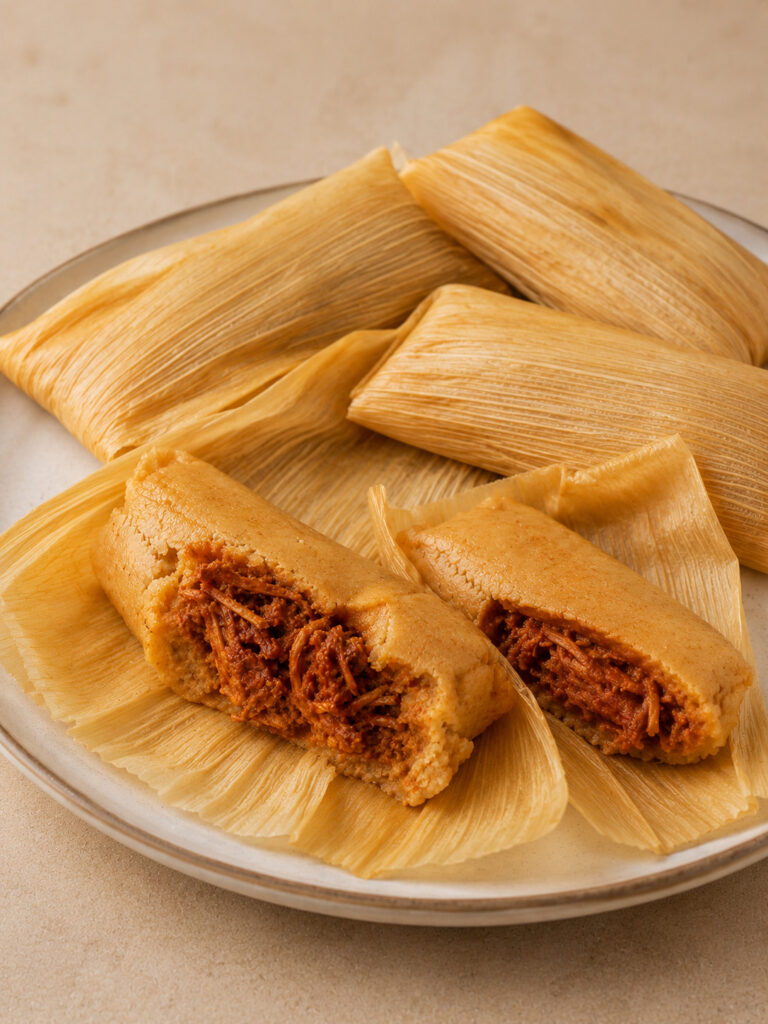
Tamales are one of those foods that feel generous before you even unwrap one. The corn husk holds in the aroma, and inside is a tender layer of masa with a filling that’s savory, saucy, and warm with chile. This version leans classic: soft corn dough, shredded chicken, and a red chile base with a little sweetness from ancho and a brighter edge from guajillo. The contrast is what makes each bite so satisfying—fluffy, moist masa against a concentrated, deeply seasoned center.
They fit just as naturally into a holiday spread as they do a weekend dinner table. A plate of tamales feels complete with beans, rice, salsa, and something cool on the side, but the tamales themselves carry plenty of character. The masa matters as much as the filling here. It should taste distinctly of corn, feel light rather than heavy, and stay tender all the way to the edges, so the wrapper opens to something cohesive instead of dense or crumbly.
What people love most about tamales is that wrapped, comforting balance. The filling is tucked neatly inside, the sauce seasons the meat without making the center watery, and the husk gives the whole thing a festive, gift-like feel. These are especially good for sharing because they hold well, reheat beautifully, and bring a sense of occasion even when the rest of the meal stays simple.
What to Serve With: Serve these with arroz rojo, frijoles de la olla or refried beans, and a bright salsa for contrast. A little crema, sliced avocado, or a crisp cabbage slaw makes the plate feel balanced. For drinks, café de olla, hot chocolate, or atole all fit beautifully.
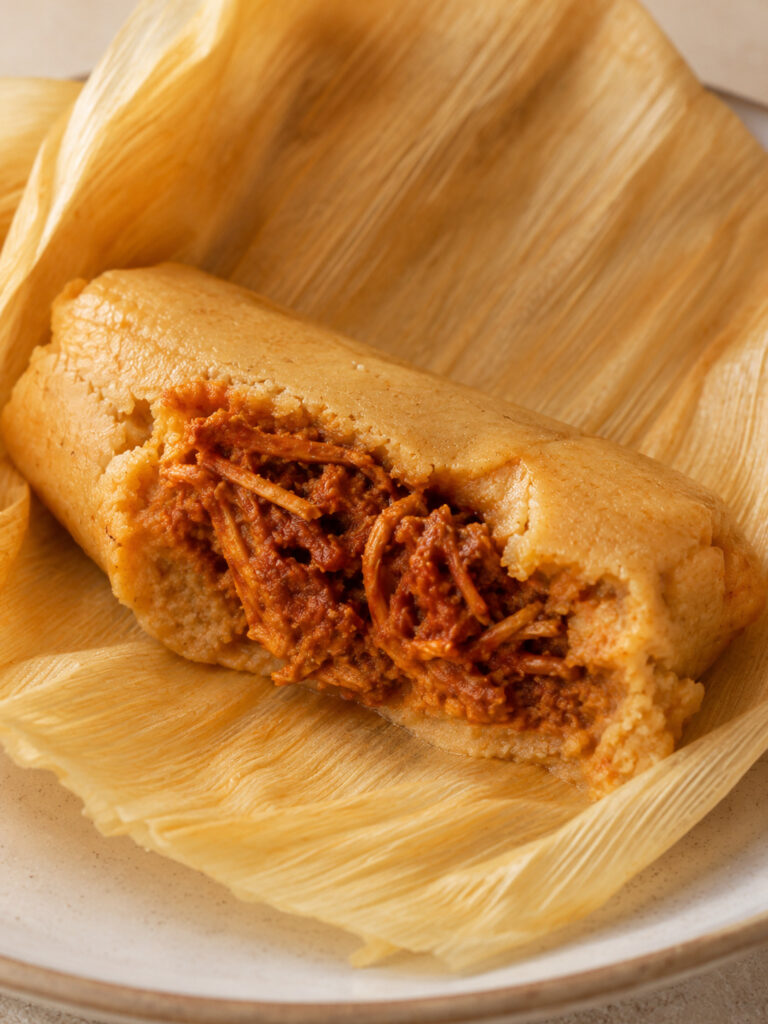
Table of contents
Tamales Ingredients
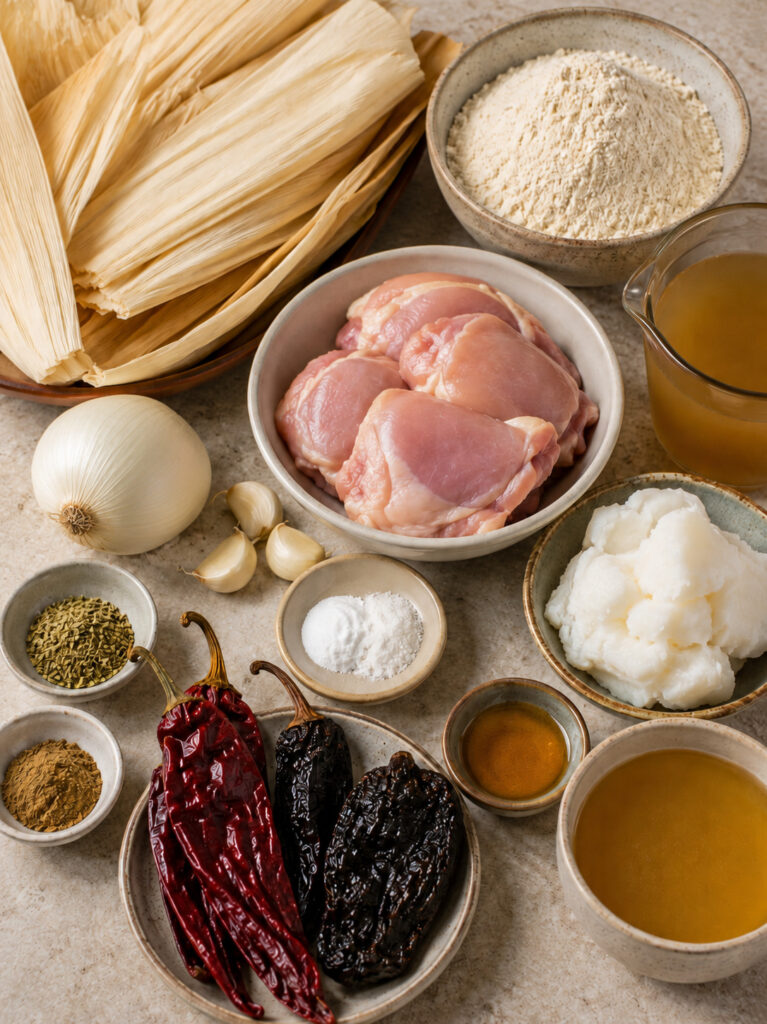
Masa harina – Choose masa harina, not plain cornmeal or polenta. Nixtamalized corn flour gives tamales their distinct corn aroma and a tender steamed crumb, while regular cornmeal stays gritty and won’t form the same soft structure. A good masa harina also gives the dough a sweeter, more rounded corn flavor.
Corn husks – Look for wide husks with fewer cracks and tears. Wider pieces make filling and folding much easier, while narrow ones are still useful as patches when one splits. After soaking, they should feel flexible and fabric-like rather than brittle.
Dried chiles – Choose pods that feel a little leathery instead of dusty and brittle. Guajillo brings a brighter, fruitier red chile flavor, while ancho adds sweetness and a deeper, rounder finish. Older chiles still work, but the sauce can taste flatter and a touch more bitter.
Lard – Fresh lard gives the masa its richest savory flavor and a softer bite. Vegetable shortening works well for structure, but the finished masa tastes a little cleaner and less full.
Storage
Fridge – Cool the tamales within 2 hours, then refrigerate in an airtight container for up to 4 days.
Freezer – Freeze well-wrapped tamales for up to 3 months for best quality.
Reheat – Steam for 15 to 20 minutes from chilled, or 25 to 30 minutes from frozen, until hot throughout. For food safety, leftovers should reach 165°F / 74°C in the center.
Allergens & Substitutions
Contains: No major allergens as written; includes corn and pork.
Masa harina: Corn is essential for the right texture and flavor. Cornmeal or polenta will not hydrate the same way and need a different formula.
Lard: Use 1 cup / 205 g vegetable shortening for similar structure. The masa will be a little less savory and slightly less plush.
Chicken thighs: Swap with 1½ lb / 680 g cooked shredded pork shoulder for a traditional option, or 4 cups / 280 g sautéed mushrooms for a meatless filling. If you use mushrooms, switch the broth in the masa to vegetable broth.
Corn husks: Use parchment paper, it’s easiest supermarket-friendly substitute. Cut it into rectangles, wrap each tamal snugly, and tie with kitchen twine if needed to keep it closed in the steamer. The tamales will cook well, but you’ll lose the corn-husk aroma and the outside will be a little softer.
Red Chile Chicken Tamales
- Total Time: 3 hours 40 minutes
- Yield: 18 tamales
Description
These tamales have soft, fluffy corn masa wrapped around juicy chicken in a deep red chile sauce with gentle warmth and a savory finish. Beating the fat until airy and adding warm broth gives the masa a lighter, more tender texture, so the tamales steam up plush instead of dense.
Ingredients
🌽 Wrappers and filling
- 30 dried corn husks (or parchment paper)
- 6 cups / 1,420 ml water
- ½ medium white onion
- 3 garlic cloves
- 1½ lb / 680 g boneless, skinless chicken thighs
- 4 guajillo chiles
- 2 ancho chiles
- 1 cup / 240 ml reserved hot cooking liquid
- 1 tbsp / 15 ml neutral oil
- 1 tsp / 2 g ground cumin
- 1 tsp / 1 g dried oregano
- 1½ tsp / 9 g kosher salt
🥣 Masa
- 4 cups / 480 g masa harina
- 2 tsp / 8 g baking powder
- 2 tsp / 12 g kosher salt
- 1 cup / 205 g lard
- 3½ cups / 840 ml warm chicken broth
- ¼ cup / 60 ml warm chicken broth (if needed to loosen the masa)
Instructions
Soak husks and make the filling
- Cover the corn husks with very warm water. Weigh them down with a plate and soak 30 to 60 minutes, until soft and bendy. Drain, rinse off any silk, and pat dry so they’re damp but not dripping.
- Add the water, onion, garlic, and chicken thighs to a pot. Bring to a gentle simmer over medium heat, then cook 18 to 22 minutes until the chicken reaches 165°F / 74°C in the thickest part. Transfer the chicken to a bowl, and reserve 1 cup / 240 ml of the hot cooking liquid.
- Remove the stems and seeds from the guajillo and ancho chiles. Cover the chiles with hot water and let them soften for 15 minutes. Blend the softened chiles with the reserved cooking liquid, the onion and garlic from the pot, cumin, oregano, and salt until very smooth.
- Heat the oil in a skillet over medium. Cook the chile sauce for 5 to 7 minutes, stirring often, until it darkens slightly and smells rounded instead of sharp. Shred the chicken, stir it into the sauce, and let the filling cool until warm, not hot.
Mix the masa
- In a medium bowl, whisk together the masa harina, baking powder, and salt.
- In a large bowl, beat the lard for 2 to 3 minutes until lighter in color and fluffy. Add the masa mixture and the 3½ cups / 840 ml warm broth in 3 additions, beating between each one, until you have a soft, smooth dough that spreads like thick hummus or cake batter. If it feels stiff or cracks when you smear a spoonful, beat in the extra ¼ cup / 60 ml broth a little at a time.
- Let the masa stand for 10 minutes, then stir once more. It should feel light and easy to spread, not dry, crumbly, or runny.
Fill and fold
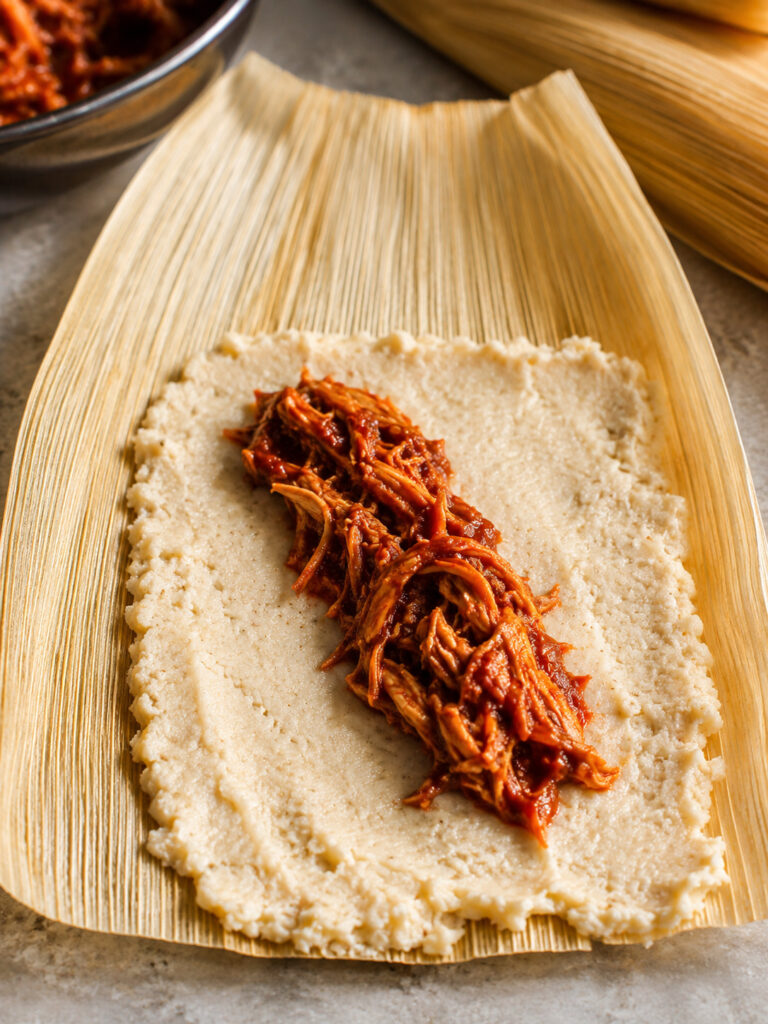
- Lay a husk smooth-side up with the wide end near you. Spread about ¼ cup / 60 ml masa into a rectangle about 4 by 5 inches / 10 by 13 cm, leaving a bare border around the sides and the narrow end.
-
(Optional) Upgrade: Save a little extra red chile sauce and spoon just a small amount over the shredded chicken before filling the tamales. It gives the center a deeper chile flavor and keeps the filling tasting juicy without making it wet enough to loosen the masa.
- Spoon about 1½ tablespoons / 22 ml filling down the center. Fold one long side over the filling, fold the other side over it, then fold the narrow end up. If a husk is narrow or torn, overlap a second husk behind it like a patch.
- Repeat with the remaining husks, masa, and filling. Stand the tamales upright with the open ends facing up as you work.
Steam and serve
- Fill the bottom of a tamale steamer, or a large pot with a steamer basket, with water just below the rack. Line the rack with a few extra husks, then arrange the tamales upright with a little space between them. Cover with a layer of damp husks or a clean damp towel, then put on the lid.
- Steam over medium to medium-high heat for 75 to 90 minutes, checking the water level after 45 minutes and adding more hot water as needed so the pot never runs dry. You want steady steam the whole time.
- Check one tamal: the husk should peel away cleanly, the masa should look matte rather than wet, and it should hold its shape but still feel tender. If it sticks to the husk or looks glossy and pasty, re-cover and steam 10 to 15 minutes more.
- Turn off the heat and let the tamales rest, covered, for 15 minutes before serving. That short rest helps the masa finish setting, so the texture turns plush instead of sticky.
Notes
- Sort the husks by size before you start, because having the widest ones ready first makes assembly much calmer.
- If you are unsure about the masa texture, steam one test tamal before building the whole batch.
- A spoon dipped in warm water or broth spreads sticky masa more easily than a dry spoon.
- Keep the filling warm or at room temperature, not cold from the fridge, so it tucks in neatly without tightening the masa.
- Make sure the steamer keeps a steady stream of steam the whole time, because stop-and-start steaming can leave the centers uneven.
- Stand the tamales with a little space between them so the steam can move around each one instead of packing them too tightly.
- If you freeze them, cool them fully first so trapped steam does not turn into icy patches inside the masa.
- These are especially good made a day ahead, because the flavor settles and the reheated texture stays lovely when steamed gently.
- Prep Time: 1 h 10 min
- Soaking: 30 min
- Cook Time: 2 hours
- Category: Main
- Cuisine: Mexican
Baker’s Percentage
- Masa harina: 100%
- Warm broth: 175% to 188%
- Lard: 43%
- Salt: 2.5%
- Baking powder: 1.7%
These percentages treat the masa harina as the base, just like flour in bread baking. Tamal dough runs much wetter than bread dough because masa harina keeps absorbing liquid as it rests and steams. A slightly looser dough usually gives you a lighter, softer tamal, while a stiffer dough tends to steam up heavier and denser. Salt mostly controls flavor here, and the lard is what helps the finished masa feel tender and plush instead of tight.
Tamales Variations
- Green chile chicken (brighter, tangier filling)
Change: Replace the 4 guajillo chiles and 2 ancho chiles with 1 lb / 450 g tomatillos and 2 poblano chiles. Blend them with the onion, garlic, and ½ cup / 120 ml cooking liquid, and keep the chicken amount the same.
Result: The filling turns fresher, tangier, and less earthy, with a lighter green-chile flavor. - Rajas with cheese (vegetarian, creamier center)
Change: Omit the chicken. Use 4 poblano chiles, 1 medium onion, and 8 oz / 225 g Oaxaca cheese (or low-moisture mozzarella), and swap the chicken broth for vegetable broth in the masa.
Result: You get a softer, milder tamal with gentle heat and little pockets of creamy, stretchy cheese. - Pork shoulder filling (richer, deeper savoriness)
Change: Replace the chicken thighs with 1½ lb / 680 g cooked shredded pork shoulder. Keep the red chile sauce the same, and use pork broth in the masa if you have it.
Result: Pork gives the filling a richer, more luxurious bite because its fat melts into the sauce as the tamales steam.
Instant Pot Option
Stand the tamales upright on a rack or steamer basket above the water line, leaving a little space so the steam can circulate. Cook on High Pressure for about 30 minutes, then let the pressure release naturally for 10 minutes before opening. Check one tamal, and if the masa still clings to the husk, add a few more minutes of pressure time or finish with a short steam on Sauté with the lid vented. The texture is usually a little more moist and tender than stovetop steaming, which is lovely here as long as the masa was not mixed too loose to begin with.
Nutrition & Dietary Information
Nutrition Facts
Low carb | ❌ |
Keto | ❌ |
High Protein | ❌ |
Gluten free | ✅ |
Low sugar | ✅ |
Dairy-free / Lactose free | ✅ |
Vegetarian | ❌ |
Vegan | ❌ |
Low sodium | ❌ |
Low Fat | ❌ |
Paleo | ❌ |
Pescatarian | ❌ |
Nut Free | ✅ |
Egg Free | ✅ |
Soy Free | ✅ |
Sesame free | ✅ |
Nutrition information is an estimate and may vary based on ingredients, brands, and portion sizes. This information is not intended as medical advice. For medical or dietary needs, calculate with your specific ingredients and consult a professional.
Diet-Friendly Swaps
High Protein: Increase the chicken filling and make the tamales a little leaner in the masa, or serve two smaller tamales with a protein-rich side like beans.
Vegetarian: Swap the chicken for mushrooms, beans, or roasted poblanos with cheese, and replace the broth and lard with vegetarian versions.
Vegan: Use mushrooms or beans for the filling, vegetable broth in the masa, and vegetable shortening instead of lard.
Low Sodium: Use low-sodium broth, cut the added salt, and let the chile flavor do more of the work.
Pesceterian: Swap the chicken for a flaky fish or shrimp filling and use a non-pork fat in the masa.
Common Problems & Fixes
Likely cause: It was underhydrated, the lard was not beaten until airy, or the dough was mixed too little.
Fix: Beat the lard until lighter and fluffy, add warm broth gradually, and aim for a soft masa that spreads easily rather than one that feels stiff or crumbly.
Likely cause: They are simply understeamed, or they were opened before the short post-steam rest.
Fix: Steam until the husk peels away cleanly, then let the tamales rest covered for 15 minutes so the masa finishes setting.
Likely cause: They were overfilled, or the masa layer was spread too thin at the sides.
Fix: Keep a clear border around the filling and use a little less chicken mixture if the husk looks hard to close neatly.
Likely cause: It is too cold or too dry, or the husks are still brittle in spots.
Fix: Loosen the masa with a little extra warm broth and keep the husks damp and flexible, not dripping wet but not dry.
Likely cause: The chile sauce did not cook long enough after blending, so the raw edge stayed behind.
Fix: Let the sauce darken and mellow in the skillet before the shredded chicken goes in, so the filling tastes deeper and smoother.
Likely cause: They were steamed just to done, then chilled without enough carryover moisture in the masa.
Fix: Make sure the masa starts generously hydrated and reheat by steaming, not dry heat, so they come back soft and plush.