
A clean, savory, unsalted vegetable stock that’s meant to disappear into your cooking (in a good way). A short, gentle simmer keeps it sweet and aromatic without drifting into bitter territory.
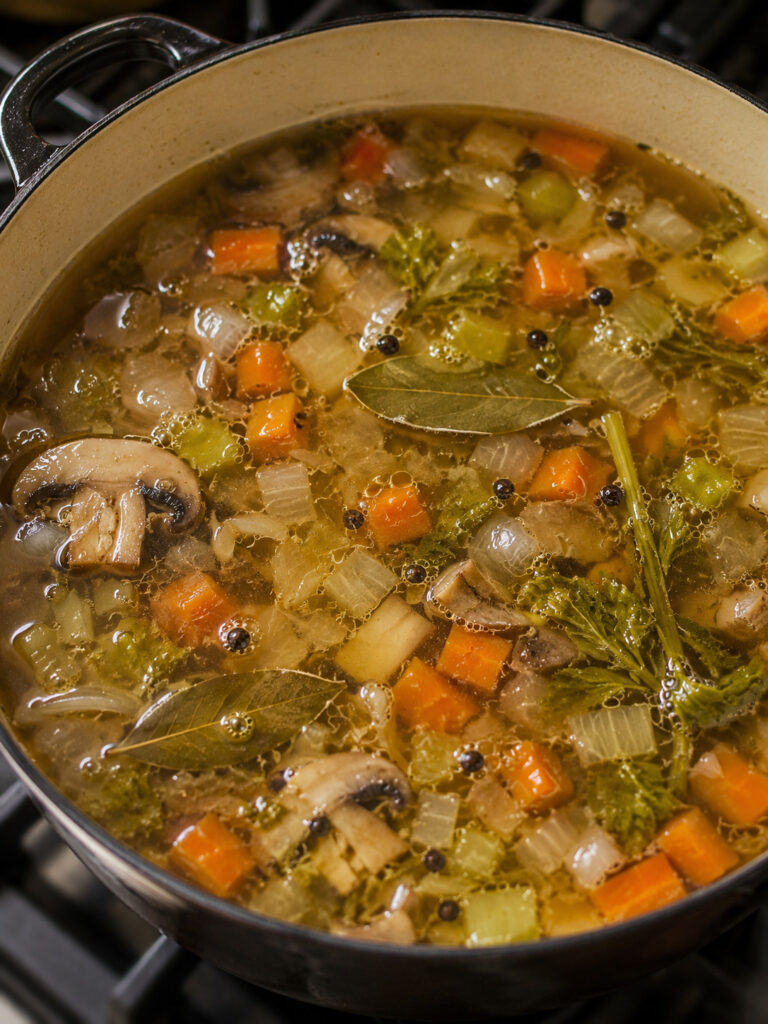
This vegetable stock is built to be a true kitchen workhorse: light golden, quietly aromatic, and flexible enough for almost any savory recipe. Because it’s unsalted, you can use it to cook rice and beans, loosen sauces, simmer grains, deglaze pans, or build soups like Italian Vegetable Soup (Minestrone) without accidentally over-seasoning.
The flavor comes from a balanced mix of alliums, carrot, and celery for classic “stock” sweetness and savoriness, plus mushrooms for gentle umami. Herbs and peppercorns add background complexity while still keeping the profile neutral. The key to loving vegetable stock is knowing when to stop: vegetables give up their best flavor quickly, and a long simmer can turn the pot bitter or muddy. Done right, you’ll get a clean-tasting stock that makes everyday cooking taste more finished, while staying mild enough to fit any cuisine direction you take it.
What to Serve With: Use this anywhere you’d normally reach for water but want more depth: cooking rice or quinoa, simmering beans or lentils, loosening refried beans, braising greens, or building soups and stews.
Vegetable stock vs vegetable broth: what’s the difference?
In everyday cooking, people often use “stock” and “broth” interchangeably, but they’re usually aiming for slightly different results.
Vegetable stock is typically designed to be a quiet, flexible base. The goal is clean, savory depth that supports whatever you’re making. That’s why stock recipes usually keep the flavor profile neutral and avoid anything that dominates (like lots of cruciferous vegetables). Stock is also commonly used in reductions (pan sauces, gravies, concentrated cooking liquids), so you want it to stay pleasant even when it’s cooked down.
Vegetable broth is usually meant to taste more “finished” on its own. It often leans more herb-forward, sometimes includes additional seasonings, and can be something you’d actually enjoy sipping. That can be great for quick soups, but it may push your final dish in one direction flavor-wise.
How to choose them for recipes:
- Use vegetable stock when you want a dependable all-purpose cooking liquid: rice, quinoa, beans, risotto, pan sauces, braises, and “anything where water feels a little sad.”
- Use vegetable broth when the liquid is meant to be a bigger part of the flavor: light soups, noodle bowls, or when you want a more herb-led profile without extra steps.
Can you swap them?
Usually, yes. If you swap broth for stock, taste earlier and adjust seasonings more cautiously (broth can be more assertive). If you swap stock for broth, you may want to add a little extra seasoning in the final dish (salt, herbs, lemon, miso, soy sauce, etc.) depending on what you’re making.
Vegetable broth is usually meant to taste more “finished” on its own. The same idea applies to other homemade cooking bases too: Chicken Stock gives soups and sauces a lighter savory base, while Beef Stock brings deeper body for stews, gravies, and braises.
Vegetable stock ingredients
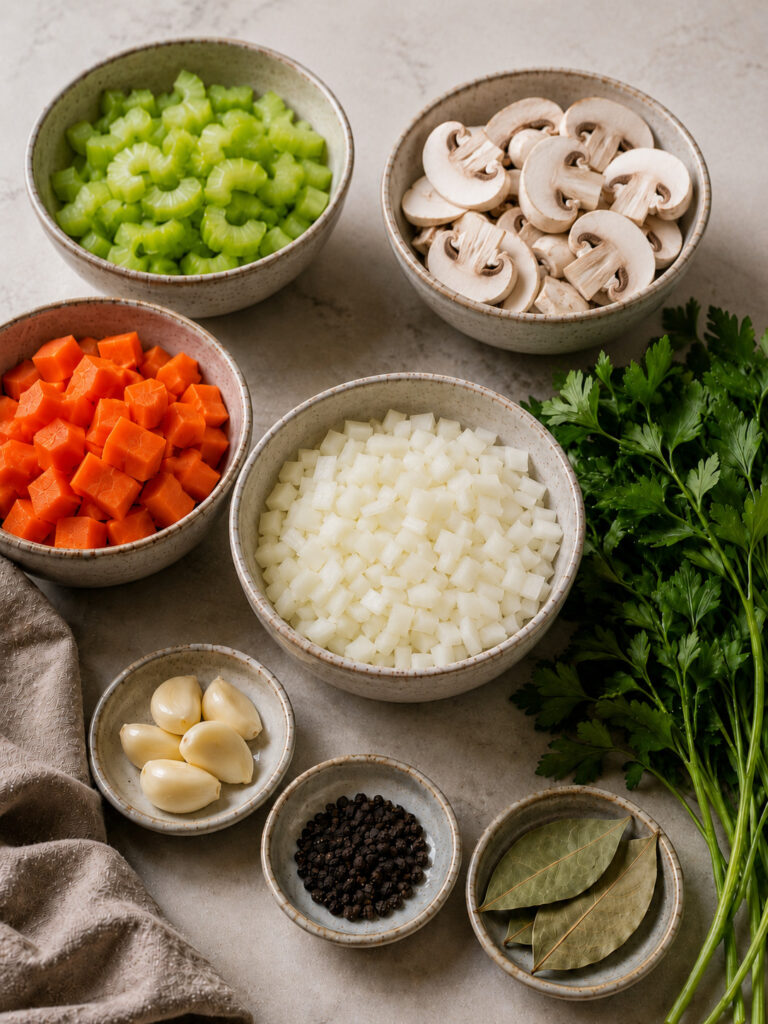
Onion – The backbone of a good stock; keeping some onion skin on (clean and papery) deepens color without adding bitterness. Swap: leeks (well-washed) for a softer, sweeter stock.
Carrot – Adds sweetness and body, but too much can make stock taste sugary; stick close to the amount listed. Swap: parsnip for a slightly earthier sweetness.
Celery – Gives that classic “stock” aroma; include the leaves for extra fragrance. If you skip celery, the stock will taste flatter, so add an extra bay leaf and more parsley stems instead.
Mushrooms – Bring gentle savory depth; brown mushrooms are especially helpful for a “more than vegetables” taste. Swap: 1/2 oz / 15 g dried mushrooms for a stronger umami note.
What to avoid – Skip cruciferous veggies (broccoli, cauliflower, cabbage, Brussels sprouts) and strong peppers; they can turn the stock bitter or overpowering.
Storage
Fridge: 4 days, tightly covered.
Freezer: 3 months (leave headspace if freezing in rigid containers).
Reheat: Warm gently on the stove over medium heat until steaming; season in the final dish, not the stock pot.
Allergens & Substitutions
Contains: none of the major allergens by default (but celery can be an allergen for some).
Substitutions: Use leeks instead of onion for a softer flavor. For gluten-free cooking, the stock is naturally gluten-free as written.
Homemade Vegetable Stock
- Total Time: 1 hour 20 minutes
- Yield: 8 cups
- Diet: Dairy-Free, Gluten-Free, Keto, Low-Carb, Paleo, Pescatarian, Vegan, Vegetarian
Description
A clean, savory, unsalted vegetable stock that’s meant to disappear into your cooking (in a good way). A short, gentle simmer keeps it sweet and aromatic without drifting into bitter territory.
Ingredients
- 1 tbsp / 15 ml – neutral oil
- 2 medium yellow onions (chopped, some clean skin optional)
- 2 medium carrots (chopped)
- 2 stalks of celery (chopped, leaves are okay)
- 8 oz / 225 g mushrooms (sliced or roughly chopped)
- 5 garlic cloves (smashed (optional))
- 2 bay leaves
- 1 tsp / 3 g black peppercorns
- 1 cup / 20 g parsley stems (optional)
- 10 cups / 2.4 L cold water (plus more as needed to cover by 1–2 inches / 2.5–5 cm)
Instructions
Start the flavor base
- Set a large pot over medium heat and add the oil.
- Add the onions, carrots, and celery. Cook 8–10 minutes, stirring often, until the onions look translucent and everything smells sweet (don’t brown).
- Stir in the mushrooms and garlic (if using). Cook 5 minutes, until the mushrooms start to soften.
Simmer gently
- Add the bay leaves, peppercorns, and parsley stems (if using). Pour in the cold water.
- Bring to a lively simmer over medium-high heat, then immediately lower to a bare simmer (just a few lazy bubbles).
- Simmer, partially covered, for 45–60 minutes. Start tasting at 45 minutes; stop when the stock tastes pleasantly savory and the vegetables look pale and “spent.” Simmering much longer can push it bitter.
Strain, cool, and store
- Turn off the heat and let the pot sit 5 minutes so solids settle.
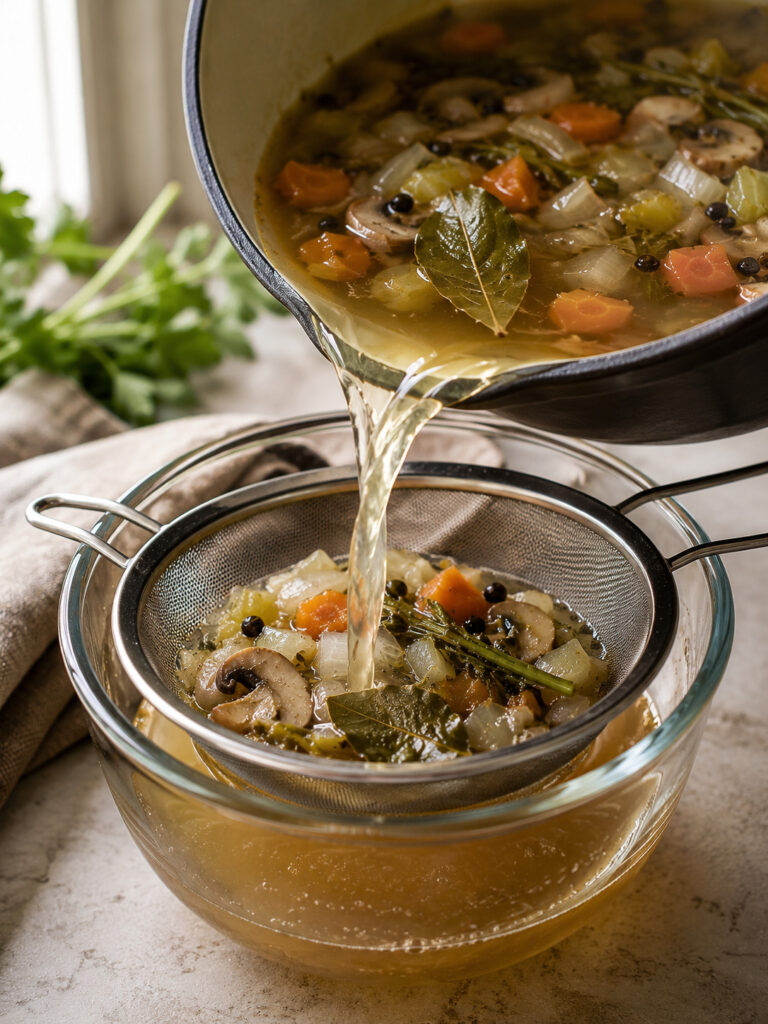
- Ladle and pour the stock through a fine-mesh strainer into a heatproof bowl or pot. Don’t press hard on the vegetables (it can cloud the stock and add harshness).
- Cool, refrigerate, then portion once fully cold. Use as-is, or simmer to reduce for a more concentrated cooking base.
Notes
Keep the simmer short and gentle. Vegetable stock gives its best flavor quickly; long cooking can go bitter.
Skip cruciferous veggies and peppers in a “universal” stock. They’re the usual reason a pot tastes sharp or funky.
Don’t overload carrots. If your stock tastes sweet, you probably had too much carrot; balance it next time with more onion/celery and mushrooms.
Leave it unsalted so it stays truly versatile, especially if you plan to reduce it for sauces.
Taste early, taste often. The perfect stopping point is when it tastes savory but still clean and bright.
For cleaner stock, don’t mash or squeeze the strained vegetables; just let it drip.
Cool fast and portion small so it chills safely and freezes in grab-and-go amounts.
Freeze in 1 cup / 240 ml portions (and a few 2 tbsp / 30 ml “flavor cubes” for pan sauces).
- Prep Time: 20 minutes
- Cook Time: 1 hour
- Category: Soup
- Cuisine: French
Pressure Cooker / Instant Pot Option
You can make this as a quick, clean pressure-cooker stock, but keep it short so the flavor stays bright. Use Sauté mode to soften the aromatics briefly (or skip sauté for the lightest taste). Add water and aromatics, then pressure cook on High for about 5 minutes. Let it naturally release for 15–20 minutes (then vent any remaining pressure). Strain as usual. Expect slightly rounder, more “cooked” flavor and a bit more cloudiness than stovetop, but still very usable for everyday cooking.
Vegetable Stock Variations
- Roasted vegetable stock (deeper, toastier)
- Change: Roast the onions, carrots, celery, and mushrooms on a sheet pan at 450°F / 230°C for 30–40 minutes, stirring once halfway. Skip the stovetop sweating step; add roasted vegetables to the pot with 10 cups / 2.4 L water, bay leaves, peppercorns, and parsley stems. Simmer 45–60 minutes, then strain and cool.
- Result: Darker color with a richer, more caramelized backbone that’s especially good for gravies, stews, and braises.
- Mushroom forward stock (extra umami, still neutral)
- Change: Increase mushrooms to 12 oz / 340 g and add 1/2 oz / 15 g dried mushrooms. Keep water at 10 cups / 2.4 L and simmer time at 45–60 minutes.
- Result: More savory depth and a rounder finish, great for risotto, lentils, and pan sauces without tasting “meaty.”
- Allium free stock (cleaner, gentler)
- Change: Omit onions and garlic. Increase celery to 4 stalks / 4 stalks and add 1 extra bay leaf / 1 extra bay leaf. Keep water at 10 cups / 2.4 L and simmer 45–60 minutes.
- Result: A lighter, more herbal stock with less sweetness that still works beautifully for grains and delicate soups.
Other Stocks
Nutrition & Dietary Information
Nutrition Facts
Low carb | ✅ |
Keto | ✅ |
High Protein | ❌ |
Gluten free | ✅ |
Low sugar | ✅ |
Dairy-free / Lactose free | ✅ |
Vegetarian | ✅ |
Vegan | ✅ |
Low sodium | ✅ |
Low Fat | ✅ |
Paleo | ✅ |
Pescatarian | ✅ |
Nut Free | ✅ |
Egg Free | ✅ |
Soy Free | ✅ |
Sesame free | ✅ |
Nutrition information is an estimate. For medical or dietary needs, calculate with your specific ingredients and consult a professional.
Common Problems & Fixes
Likely cause: Too much water for the amount of veg (or the pot is wide so the veg isn’t packed in), plus minimal evaporation.
Fix: After straining, simmer the liquid down 15–30 minutes to concentrate, or next time add more mushrooms/onion and keep the water just to “cover + a little.”
Likely cause: The veggies browned or caught on the bottom during the first cook (heat too high, thin pot, not enough stirring).
Fix: Keep the heat at a gentle sizzle and add a splash of water the moment you see browning; if it’s already harsh, dilute with a little water and use it in strongly flavored dishes (stews, braises) rather than delicate soups.
Likely cause: Too much papery onion skin/dried allium “paper,” or heavy-handed bay leaves/peppercorns.
Fix: Use only a small piece of clean yellow onion skin (skip the brittle paper scraps), stick to 1–2 bay leaves, and keep peppercorns modest.
Likely cause: Dirt on mushrooms or sandy celery leaves got into the pot, or tiny particles slipped through the strainer.
Fix: Wipe/rinse mushrooms, swish celery in water, and strain through a finer setup (damp cheesecloth, a coffee filter, or a second pass).
Likely cause: A bit too much oil for the amount of liquid, or the oil emulsified from hard boiling.
Fix: Chill the stock and lift off the fat layer, then reheat gently; if you want it ultra-clean, start with a smaller amount of oil next time.