
A clear, savory, unsalted chicken stock that’s built to disappear into whatever you’re cooking. Keeping the aromatics restrained and the simmer gentle gives you clean flavor now, plus plenty of room to season later.
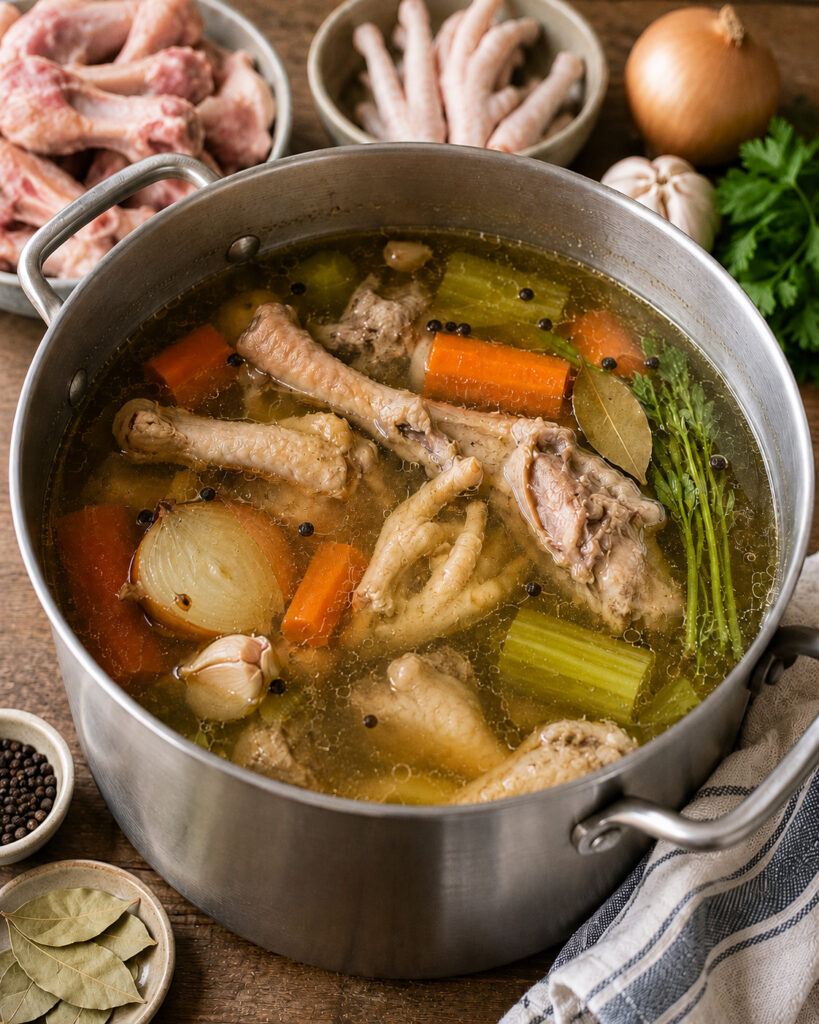
Your all purpose flavor base
Think of this as your “blank canvas” stock: light golden, clean, chicken-forward, and quietly aromatic. Because it’s unsalted, you can use it anywhere without accidentally over-seasoning, whether you’re building soups, cooking grains, deglazing a pan sauce, or braising vegetables.
The body comes from collagen-rich chicken parts, which can set up slightly gel-like when chilled (that’s a good sign). The vegetables stay in the background, adding sweetness and savoriness without turning the stock into “vegetable soup.”
A couple of bay leaves and peppercorns give a subtle backbone, while keeping the profile neutral enough for everything from risotto to stews to gravy. The end result is the kind of stock that makes simple food taste finished: beans feel richer, noodles taste more “chicken-y,” and sauces cling a little better. It’s also a smart freezer staple, so you can cook with depth on busy nights without doing anything fancy.
What to Serve With: Use it anywhere water would feel a little sad: soups like Minestrone, stews like Red Pork and Hominy Stew (Pozole Rojo), lentils, beans, rice, risotto, orzo, and braises.
Chicken Stock vs Chicken Broth: What’s the Difference?
Chicken stock is usually made with bones (plus joints/skin, and sometimes a bit of meat), then simmered long enough to pull out collagen and minerals. That collagen is the big giveaway: a good stock feels silkier, and it may even gel in the fridge. Because it’s built for cooking, stock is commonly left unsalted, so you can reduce it for sauces, build soups without oversalting, and season your final dish precisely.
Chicken broth is typically more meat-forward and often seasoned so it tastes good right out of the pot (or carton). The texture is usually lighter and less “sticky” on the lips because there’s less collagen in the mix. Broth is a great choice when you want something that’s closer to a finished soup base, especially for simple noodle soups or when you’re sipping it on its own.
In practice, store-bought labels can get fuzzy: plenty of cartons labeled “stock” are basically broth (and vice versa). The most reliable clue is the ingredient list and sodium: if it’s already salty, it’ll behave more like broth in recipes. A quick home test helps too: chill it overnight. If it turns jiggly, you’re working with something stock-like.
When swapping one for the other, the main adjustment is salt (and sometimes richness). If you use broth in place of unsalted stock, hold back on added salt until the end. If you use stock where broth is expected, you may simply need a pinch more salt and maybe a brighter finishing note (lemon, herbs) to make the flavors pop.
Table of contents
Chicken stock ingredients
Chicken bones and parts – Use a mix of backs, wings, necks, and/or a carcass with some meat still attached for the best flavor. A collagen booster (chicken feet, if you’re comfortable with them) makes a noticeably silkier stock.
Water level – Aim for enough cold water to cover the chicken by about 1 inch / 2.5 cm; roughly 3–4 cups water per 1 lb / 450 g chicken is a good home-kitchen target.
Aromatics (onion, carrot, celery) – Keep the carrot modest; too much can make the stock taste sweet. If you want a more neutral stock, use less carrot rather than skipping onion and celery.
Bay leaf and peppercorns – Whole peppercorns give gentle warmth without muddying the stock; ground pepper can make it taste harsh and look speckled.
Vinegar (optional) – A tiny splash can help with mineral extraction, but keep it subtle so the stock stays versatile; you shouldn’t “taste vinegar” in the finished stock.
Chicken stock variations
- Deep golden stock (richer, roastier)
- Change: Roast the chicken bones (and feet, if using) on a sheet pan at 450°F / 230°C for 35–45 minutes until deeply browned. Roast the onion, carrot, and celery for the last 20 minutes. Add everything to the pot, pour 1 cup / 240 ml hot water onto the sheet pan, scrape up the browned bits, and add that liquid too. Simmer 3 to 4 hours as written.
- Result: Darker color and a toastier, more savory backbone that’s especially great for gravy, stews, and pan sauces.
- Quick carcass stock (lighter, faster)
- Change: Use 2 lb / 900 g picked-over cooked chicken carcass (plus any skin/bones). Reduce water to 8 cups / 1.9 L. Simmer 1 hour 30 minutes to 2 hours, then strain and cool as written.
- Result: Cleaner, lighter stock with less body than the full batch, but still plenty flavorful for soups and cooking grains.
- Herb finish stock (brighter aroma)
- Change: Add 10 sprigs / 10 sprigs fresh thyme (or 1 tsp / 1 g dried thyme) during the last 30 minutes of simmering. Keep the bay leaves the same.
- Result: A gently fragrant stock that still stays versatile, with a fresher, more “lifted” aroma.
Storage
Fridge: 4 days, tightly covered.
Freezer: 3 months (freeze flat in bags or in 1–2 cup portions for easy grabbing).
Reheat: Warm gently on the stove over medium-low heat until steaming; avoid a hard boil if you want it to stay clear.
Allergens & Substitutions
Contains: none of the major allergens by default (but check your final dish).
Substitutions: Use turkey parts 1:1 for turkey stock. If avoiding alliums, skip onion and garlic and increase celery to 4 stalks / 240 g for more savoriness (the stock will taste cleaner and slightly less sweet).
Homemade Chicken Stock
- Total Time: 3 hours 20 minutes
- Yield: 8 to 10 cups
- Diet: Dairy-Free, Keto, Low-Carb
Description
A clear, savory, unsalted chicken stock that’s built to disappear into whatever you’re cooking. Keeping the aromatics restrained and the simmer gentle gives you clean flavor now, plus plenty of room to season later.
Ingredients
4 lb / 1.8 kg – chicken backs/wings/necks (or mixed bones with some meat)
0.5 lb / 225 g – chicken feet (optional, for extra gelatin)
1 large / 200 g – yellow onion (quartered (leave the skin on for deeper color, optional)
2 medium / 200 g – carrots (cut into 2-inch / 5 cm chunks)
2 stalks / 120 g – celery (cut into 2-inch / 5 cm chunks)
4 garlic cloves (smashed, optional)
2 bay leaves
1 tsp / 3 g – black peppercorns
1 cup / 20 g – parsley stems (optional)
2 tsp / 10 ml – apple cider vinegar (optional)
12 cups / 2.8 L – cold water (plus more as needed to keep things covered)
Instructions
Build the pot
- Add the chicken (and chicken feet, if using) to a large stockpot. Scatter in the onion, carrots, celery, garlic (if using), bay leaves, peppercorns, and parsley stems.
- (Optional) Upgrade: For the cleanest, clearest stock, do a quick blanch-and-rinse of the chicken parts first (a fast boil, drain, rinse, then start the stock). It removes a lot of the blood/protein that turns into foam, so the finished stock tastes extra “pure” and looks prettier.
- Add the vinegar (if using). Pour in the cold water, adding a little more if needed so the chicken is covered by about 1 inch / 2.5 cm.
Gentle simmer and skim
- Set the pot over medium-high heat and bring it just to the edge of a boil. As soon as you see steady bubbles rising, immediately lower the heat to maintain a bare simmer (a few lazy bubbles, not a rolling boil).
- Skim off any gray foam that collects on the surface during the first 20–30 minutes. This helps keep the stock tasting clean and looking clear.
- Simmer, partially covered, for 3 to 4 hours, checking every 45–60 minutes. Add a splash of hot water if the bones start peeking above the surface.
Strain, cool, and store
- Turn off the heat. Let the pot sit for 10 minutes so the contents settle a bit.
- Using tongs, lift out the larger bones and vegetables. Then carefully ladle and pour the stock through a fine-mesh strainer into a large heatproof bowl or pot.
- Cool the stock quickly: set the container in an ice-water bath (or divide into wide, shallow containers). Stir occasionally until no longer steaming hot, then refrigerate.
- Chill until the fat rises and firms up (at least 6 hours, or overnight). Lift off the fat cap for a cleaner, more versatile stock.
- Portion and store. If you want a more concentrated stock for sauces, simmer the strained stock on its own until reduced to your liking, then cool and store as above.
Notes
Keep it at a bare simmer. A hard boil can turn stock cloudy and dull the flavor.
Start with cold water so the flavors extract gradually and the stock tastes “round,” not harsh.
Don’t overdo the carrot. Too much can push the stock into sweet territory; keep it supportive, not dominant.
Skip strong veggies like broccoli, cabbage, or Brussels sprouts here; they can make stock bitter and funky when cooked for hours.
Leave it unsalted. You’ll season the final dish more accurately, especially if you reduce the stock later or use it in recipes like Chicken Enchiladas or Chicken Tamales.
Want that jiggle when chilled? Add chicken feet (or a few extra wings). Gelatin = better mouthfeel.
For the cleanest flavor, strain sooner rather than later once you’re happy with the taste; overcooked aromatics can muddy things.
Cool it fast and portion it small. Big, deep containers stay warm too long in the fridge and can be a food-safety headache.
- Prep Time: 20 minutes
- Cook Time: 3 hours
- Category: Soups
Pressure Cooker/Instant Pot Option
Don’t fill past the max line, and keep the water just covering the chicken parts so the flavor stays concentrated. Cook on high pressure 45 minutes for a clean, everyday stock, or 60 minutes for a richer, more gelatinous result. Let it naturally release at least 20 minutes (then you can vent the rest) to prevent a violent boil that can cloud the stock.
If you want it extra-clean tasting, skim any foam that rises while you’re bringing it up to pressure. Strain right away, then chill completely so the fat rises and firms up for easy removal. If it tastes a touch “tight” straight from the pot, it often mellows after chilling and reheating gently.
Other Stocks
Nutrition & Dietary Information
Nutrition Facts
Low carb | ✅ |
Keto | ✅ |
High Protein | ❌ |
Gluten free | ✅ |
Low sugar | ✅ |
Dairy-free / Lactose free | ✅ |
Vegetarian | ✅ |
Vegan | ✅ |
Low sodium | ✅ |
Low Fat | ❌ |
Paleo | ✅ |
Pescatarian | ❌ |
Nut Free | ✅ |
Egg Free | ✅ |
Soy Free | ✅ |
Sesame free | ✅ |
Common Problems & Fixes
Likely cause: The pot hit a boil (or got stirred a lot), which breaks fat/protein into tiny particles that stay suspended.
Fix: Keep the heat at the gentlest simmer you can manage and avoid stirring; if it’s already cloudy, chill, lift off the fat cap, then strain again through a very fine filter.
Likely cause: Too much water for the amount of bones/skin/joints, or the pot was topped up repeatedly so it never concentrates.
Fix: Next time, start with just enough water to cover; for this batch, simmer the strained stock to reduce until it tastes chicken-forward.
Likely cause: The aromatic mix leaned carrot-heavy or the carrots were very sweet.
Fix: Reduce sweetness by simmering the strained stock with a little extra celery (or a small splash of dry white wine) for 15–20 minutes, then strain again.
Likely cause: Aromatics or herbs (especially bay) simmered too long, or roasted bits got a little too dark.
Fix: Strain as soon as the flavor is right; for a mild rescue, dilute with a little fresh water and re-warm gently with a fresh onion wedge for 10 minutes, then strain.
Likely cause: Not enough collagen-rich parts (skin, wings, feet, joints), or it was diluted.
Fix: Treat it as a perfectly usable light stock, or reduce it a bit for more body; next time, add more wings/feet or include more jointy pieces.
Likely cause: Too much rendered fat stayed in the liquid, or the stock boiled and emulsified fat into the broth.
Fix: Chill fully, lift off the fat cap, then reheat gently; if it’s emulsified, strain through a coffee filter (slow but effective) for a cleaner mouthfeel.