
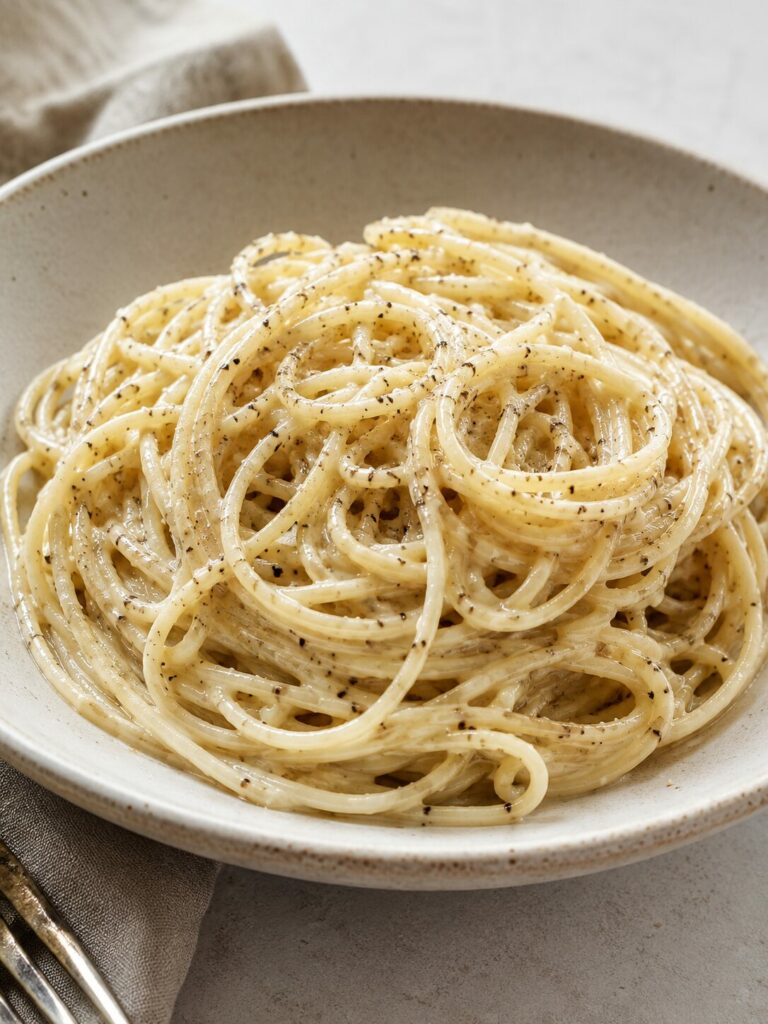
Cacio e Pepe is a Roman pasta built from spaghetti, Pecorino Romano, black pepper, pasta water, and almost nothing else. The whole dish depends on a glossy off-heat emulsion, which is why very fine grating and gentle heat matter so much.
Cacio e Pepe is one of Rome’s great pasta dishes, and its charm sits in how much flavor can come from so little. The bowl tastes direct and vivid: salty, tangy Pecorino Romano, warm black pepper heat, and a sauce that feels creamy and light at the same time. There’s no butter, no cream, and nothing softening the edges. Instead, the finish stays clean and savory, while each strand looks lightly lacquered rather than buried under a thick blanket of sauce.
That balance is why it works for both a quiet weeknight dinner and a dinner-party first course. It feels cozy, yet a little dramatic, because the aroma arrives before the plate does. You get peppery perfume first, then the firm sheep’s-milk sharpness, then the glossy slip of pasta water and cheese together. The dish is loved because it turns pantry basics into something focused and luxurious, with no distractions and nowhere for technique to hide.
The key components are simple but particular. Pecorino Romano is dry, assertive, and prone to clumping, so texture matters as much as flavor. Freshly cracked black pepper gives the dish its floral edge and gentle bite, while long pasta keeps the sauce moving in shiny strands that feel elegant and easy to twirl. In the best version, the pasta lands glossy, pepper-flecked, and fluid enough to move in the bowl, with a sauce that clings instead of clots.
What to Serve With: A crisp green salad with lemony dressing is perfect, because the brightness cuts through the salty cheese. Bitter greens, roasted artichokes, or sautéed zucchini also fit beautifully. For the table, keep it simple: extra black pepper, cold sparkling water, and maybe a dry white wine.
Table of contents
Cacio e Pepe Ingredients
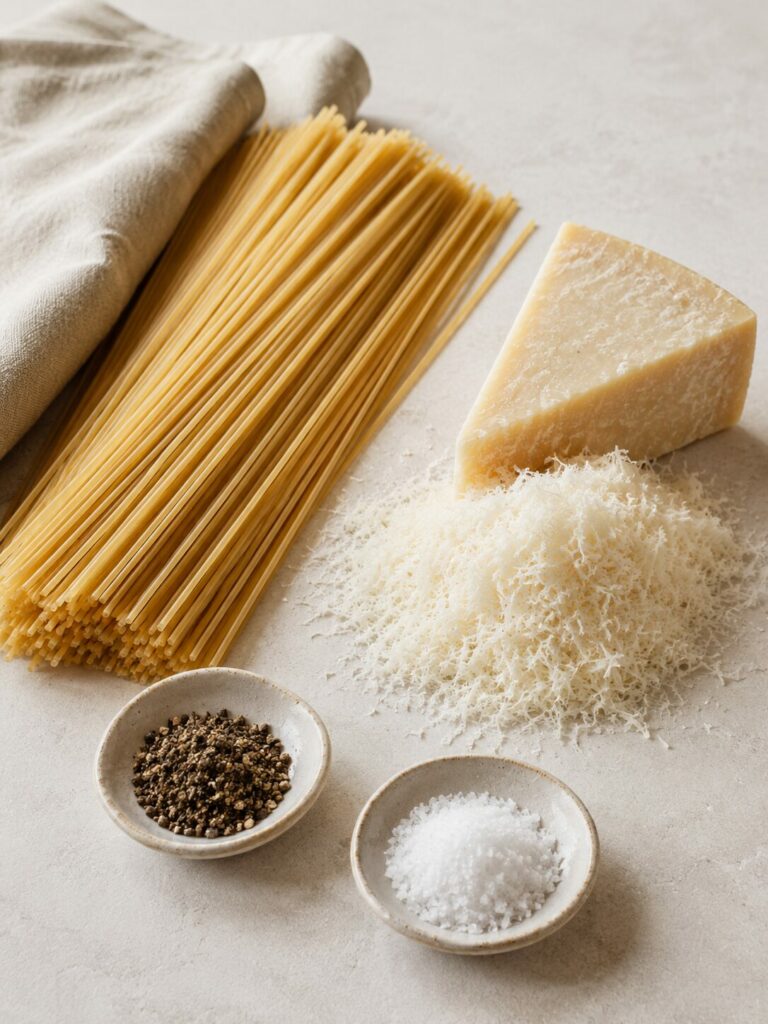
Pecorino Romano – Choose a wedge and grate it very finely yourself; pre-shredded cheese is usually drier and often less cooperative in a smooth sauce. This cheese gives the dish its salty, sheepy sharpness, but it also clumps quickly when overheated. A very fine grate gives you a silkier finish and a more even cheese flavor in every bite.
Black pepper – Freshly cracked pepper should smell warm and floral, not dusty or flat. It matters here because pepper is not a background seasoning; it is one of the dish’s main flavors. A slightly coarse grind gives tiny bursts of heat and visible specks instead of a dull, muddy look.
Spaghetti or tonnarelli – Long pasta gives this sauce its classic drape and twirl. A rougher, bronze-die dried pasta holds the emulsion better, so the bowl looks glossier and tastes more cohesive. Tonnarelli gives a chewier bite, while spaghetti feels a little lighter and more familiar.
Storage
Fridge – Refrigerate within 2 hours in a shallow container and eat within 3 to 4 days. The sauce will tighten as it chills, so expect a firmer texture the next day.
Freezer – Freeze for up to 2 months for the best texture; officially, cooked leftovers stay safe in the freezer for 3 to 4 months, but this pasta loses quality before that.
Reheat – Warm gently in a skillet over low heat with 1 to 3 tbsp / 15 to 45 ml water until loosened and steaming hot. For food safety, reheat leftovers to 165°F / 74°C.
Allergens & Substitutions
Contains: milk, wheat
Pecorino Romano: Parmigiano Reggiano works 1:1 for a milder, nuttier bowl, though the classic sharp sheep’s-milk bite will soften.
Spaghetti or tonnarelli: Bucatini or rigatoni work 1:1; short pasta usually needs a bit more reserved water to stay glossy.
Wheat pasta: A sturdy gluten-free spaghetti can work 1:1, but some brands release less starch, so start with less pasta water and add only as needed.
Cacio e Pepe
- Total Time: 25 min
- Yield: 4 servings
Description
At its core, Cacio e Pepe is a minimalist Roman dish combining spaghetti, Pecorino Romano, black pepper, and starchy pasta water. The magic lies in creating a silky emulsion away from direct heat, which makes precise grating and careful temperature control crucial to getting it right.
Ingredients
🍝 Pasta Base
- 12 oz / 340 g – spaghetti or tonnarelli
🧀 Peppery Finish
- 2 tsp / 5 g – coarsely ground black pepper
- 2 cups / 170 g – finely grated Pecorino Romano (or Parmesan)
Instructions
Get Ready
- Finely grate the Pecorino Romano on the small holes of a box grater and place it in a large heatproof mixing bowl.
- Crush or grind the black pepper so it is coarse but not chunky.
- In a large deep skillet or sauté pan, bring the water and salt to a boil over high heat.
Cook the Pasta
- Add the pasta and cook, stirring often, until al dente, about 9 to 11 minutes for spaghetti or according to the package for your pasta.
- About 2 minutes before the pasta is done, scoop out 2 cups / 480 ml of pasta water. Drain the pasta and let it stand for 30 seconds so it stops boiling hard.
Build the Sauce
- Return the empty skillet to low heat. Add the black pepper and ¼ cup / 60 ml of the reserved pasta water. Let it bubble for 20 to 30 seconds, just until the pepper smells fragrant.
- Scrape the peppery liquid into the bowl with the cheese. Whisk in ½ cup / 120 ml reserved pasta water, a little at a time, until you have a thick, smooth paste. If it starts to look stringy, stop and whisk in 1 to 2 tbsp / 15 to 30 ml more water before continuing.
- Add the drained pasta to the bowl and toss hard with tongs for 30 to 60 seconds. Add more reserved pasta water, 1 tbsp / 15 ml at a time, until the sauce loosens into a glossy coating.
- Serve immediately. Success looks like silky strands with no cheese clumps and no oily puddles; the sauce should cling lightly, look shiny, and still move when you twirl the pasta.
Notes
- Use a bowl bigger than you think you need, because wide, fast tossing helps the sauce emulsify instead of matting.
- Save more pasta water than feels necessary, because the last little splash is often what turns the sauce from pasty to glossy.
- A rough, bronze-die pasta holds the emulsion better, so the bowl tastes more connected and looks shinier.
- Warm the serving bowls gently, not fiercely, so the sauce stays fluid instead of tightening on contact.
- Cooking the pasta in a relatively modest amount of water gives you starchier water, which makes the sauce much more forgiving.
- Scoop your reserved water when it looks properly cloudy, because early, clearer water will not help the emulsion nearly as much.
- Use tongs for the final toss so you can lift and stretch the strands; that movement coats long pasta better than simple stirring.
- Prep Time: 10 min
- Cook Time: 15 min
- Cuisine: Italian
Nutrition & Dietary Information
Nutrition Facts
Low carb | ❌ |
Keto | ❌ |
High Protein | ✅ |
Gluten free | ❌ |
Low sugar | ✅ |
Dairy-free / Lactose free | ❌ |
Vegetarian | ✅ |
Vegan | ❌ |
Low sodium | ❌ |
Low Fat | ❌ |
Paleo | ❌ |
Pescatarian | ✅ |
Nut Free | ✅ |
Egg Free | ✅ |
Soy Free | ✅ |
Sesame free | ✅ |
Nutrition information is an estimate and may vary based on ingredients, brands, and portion sizes. This information is not intended as medical advice. For medical or dietary needs, calculate with your specific ingredients and consult a professional.
Diet-Friendly Swaps
Gluten Free: Use a sturdy certified gluten-free spaghetti and start with a little less pasta water, since many gluten-free brands release less starch.
Vegan: Swap in a firm vegan pecorino-style cheese or another aged vegan hard cheese, and expect to rely a little more on starch for body.
Dairy/Lactose Free: Use a dairy-free hard cheese alternative, because the exact recipe as written is dairy-based.
Low Carb: Replace the pasta with hearts of palm noodles or another low-carb noodle, knowing the result will be inspired by cacio e pepe rather than fully classic.
Keto: Use a very-low-carb noodle such as shirataki and keep the sauce quite tight so it still clings.
Paleo: Use a paleo-friendly vegetable noodle and a non-dairy cheesy substitute, though the dish will read as a variation rather than a classic Roman bowl.
Common Problems & Fixes
Likely cause: The pasta or bowl is still too hot when the cheese goes in, so the proteins seize.
Fix: Build the cheese paste first, keep the emulsion off direct heat, and if it starts to look stringy, whisk in a small splash of slightly cooler water before adding more.
Likely cause: The reserved water is not starchy enough, or too much water was added too quickly.
Fix: Use the cloudiest pasta water you have and add it a spoonful at a time while tossing hard, stopping as soon as the strands look lightly lacquered.
Likely cause: The skillet stayed on the burner after the cheese was added, or the pepper liquid reduced too far before mixing.
Fix: Finish the emulsion fully off heat and loosen with warm reserved water instead of trying to cook the sauce down.
Likely cause: The pepper was ground too far ahead or never briefly bloomed, so its floral edge faded.
Fix: Crack the pepper fresh and warm it briefly with a little pasta water until fragrant, not dark or scorched.
Likely cause: The cheese was grated too coarsely or came from a pre-shredded bag.
Fix: Grate from a wedge on the fine holes and whisk it into a smooth paste before it meets the pasta.