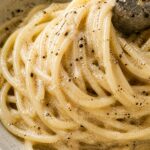
Description
At its core, Cacio e Pepe is a minimalist Roman dish combining spaghetti, Pecorino Romano, black pepper, and starchy pasta water. The magic lies in creating a silky emulsion away from direct heat, which makes precise grating and careful temperature control crucial to getting it right.
Ingredients
🍝 Pasta Base
- 12 oz / 340 g – spaghetti or tonnarelli
🧀 Peppery Finish
- 2 tsp / 5 g – coarsely ground black pepper
- 2 cups / 170 g – finely grated Pecorino Romano (or Parmesan)
Instructions
Get Ready
- Finely grate the Pecorino Romano on the small holes of a box grater and place it in a large heatproof mixing bowl.
- Crush or grind the black pepper so it is coarse but not chunky.
- In a large deep skillet or sauté pan, bring the water and salt to a boil over high heat.
Cook the Pasta
- Add the pasta and cook, stirring often, until al dente, about 9 to 11 minutes for spaghetti or according to the package for your pasta.
- About 2 minutes before the pasta is done, scoop out 2 cups / 480 ml of pasta water. Drain the pasta and let it stand for 30 seconds so it stops boiling hard.
Build the Sauce
- Return the empty skillet to low heat. Add the black pepper and ¼ cup / 60 ml of the reserved pasta water. Let it bubble for 20 to 30 seconds, just until the pepper smells fragrant.
- Scrape the peppery liquid into the bowl with the cheese. Whisk in ½ cup / 120 ml reserved pasta water, a little at a time, until you have a thick, smooth paste. If it starts to look stringy, stop and whisk in 1 to 2 tbsp / 15 to 30 ml more water before continuing.
- Add the drained pasta to the bowl and toss hard with tongs for 30 to 60 seconds. Add more reserved pasta water, 1 tbsp / 15 ml at a time, until the sauce loosens into a glossy coating.
- Serve immediately. Success looks like silky strands with no cheese clumps and no oily puddles; the sauce should cling lightly, look shiny, and still move when you twirl the pasta.
Notes
- Use a bowl bigger than you think you need, because wide, fast tossing helps the sauce emulsify instead of matting.
- Save more pasta water than feels necessary, because the last little splash is often what turns the sauce from pasty to glossy.
- A rough, bronze-die pasta holds the emulsion better, so the bowl tastes more connected and looks shinier.
- Warm the serving bowls gently, not fiercely, so the sauce stays fluid instead of tightening on contact.
- Cooking the pasta in a relatively modest amount of water gives you starchier water, which makes the sauce much more forgiving.
- Scoop your reserved water when it looks properly cloudy, because early, clearer water will not help the emulsion nearly as much.
- Use tongs for the final toss so you can lift and stretch the strands; that movement coats long pasta better than simple stirring.
- Prep Time: 10 min
- Cook Time: 15 min
- Cuisine: Italian