
This pizza dough bakes up crisp on the outside with a chewy, tender bite inside, even in a regular home oven. A simple flour-water-yeast-salt base gives you clean flavor and a stretchy dough that’s easy to shape.
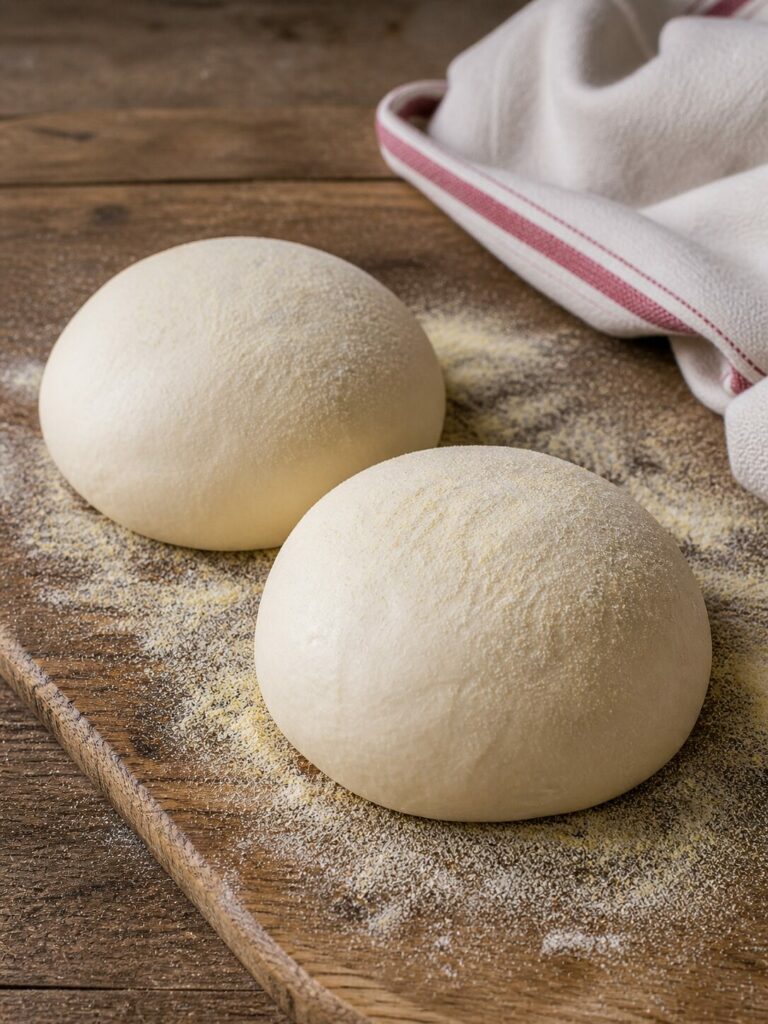
A great pizza starts with a dough that feels alive in your hands and bakes into a crust with real character. This one gives you a lightly blistered, golden edge, a thin-but-chewy center, and that satisfying “tear” when you fold a slice. The flavor is clean and wheaty with a gentle savoriness from the salt and a soft, rounded finish from a touch of olive oil. Because the dough is moderately hydrated, it stays easy to handle while still turning airy and tender once it hits high heat.
It’s the kind of crust that works with everything: a simple tomato sauce and mozzarella, a white pie with garlic and ricotta, or a pile of roasted vegetables. You’ll love it for weeknight pizza nights because it’s dependable and forgiving, but it’s also good enough to make you want to keep a couple dough balls in the fridge for whenever the craving hits. If you’ve ever wanted a crust that’s crisp underneath, puffy at the rim, and still pleasantly chewy, this is your go-to.
Table of contents
Pizza Dough Ingredients
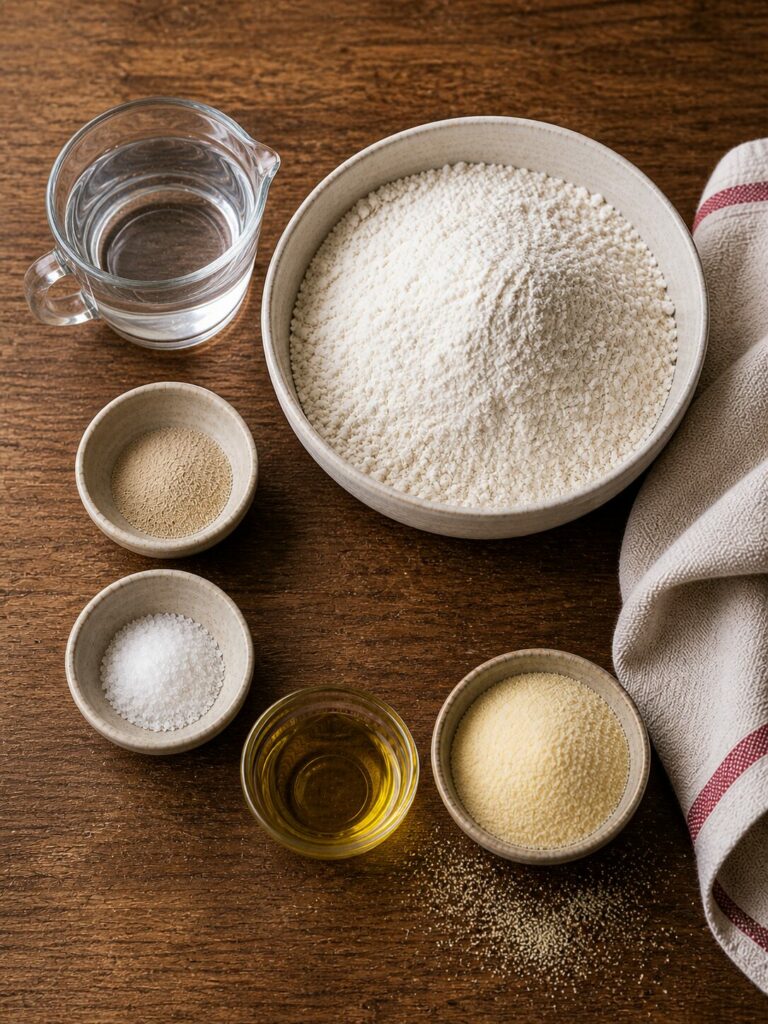
Bread flour – Higher-protein flour gives a chewier crust and a rim that puffs nicely. All-purpose flour works too; the dough may feel a bit softer and the crust a touch less springy. If the dough seems sticky, resist adding lots of flour right away—give it a 10-minute rest and it will usually firm up as the flour hydrates.
Warm water – Aim for lukewarm, not hot, so the yeast wakes up without getting stressed (about 95–105°F / 35–41°C). Cooler water slows the rise; warmer water speeds it up, which can reduce flavor. If your kitchen is very warm, use the lower end of the range for better control.
Active dry yeast – This recipe assumes active dry yeast; if you use instant yeast, it can go in with the flour and you’ll usually see a slightly faster rise. If your yeast is old, the dough may barely rise—proof it first so you don’t waste the flour.
Fine sea salt – Salt strengthens gluten and keeps the crust from tasting flat. If you’re using kosher salt, the volume can vary a lot; weighing is the easiest way to keep the seasoning consistent.
Olive oil – Adds tenderness and helps browning. If you skip it, the dough will still work, but it can feel a little drier and tighter when you stretch it.
Semolina or cornmeal (optional) – A light dusting can help the dough slide onto a hot stone/steel. If you don’t have it, use a small amount of flour plus parchment; parchment is the most foolproof for beginners.
Pizza Dough Variations
1. All-purpose only: If you don’t have bread flour, this still works beautifully.
Change: Use 3 1/2 cups / 440 g all-purpose flour (instead of bread flour). If the dough feels too soft, hold back 2 tbsp / 15 g flour and add only if needed during mixing.
Result: A slightly more tender, less chewy crust that browns easily—great for thinner pizzas.
2. Whole wheat blend: Adds a nutty note without turning the crust heavy.
Change: Replace 1 cup / 120 g of the bread flour with whole wheat flour. Increase water to 1 1/3 cups / 315 ml.
Result: A sturdier dough with a toasty flavor and a slightly denser bite (whole wheat absorbs more water).
3. Overnight flavor boost: Slow fermentation gives more complexity and easier stretching.
Change: Reduce yeast to 1 tsp / 3 g. Refrigerate dough balls 24–48 hours after dividing. Bring to room temperature 90–120 minutes before shaping.
Result: More developed flavor and a dough that stretches with less fight, thanks to slow gluten relaxation.
Storage
Fridge: Keep dough balls covered up to 3 days and let it sit at room temp 60 to 120 minutes before stretching.
Freezer: Freeze lightly oiled dough balls in sealed bags up to 2 months; thaw overnight in the fridge.
Reheat: Reheat baked slices on a skillet over medium heat 2 to 4 minutes (cover for 1 minute to melt cheese), or in a 425°F / 220°C oven 5 to 7 minutes.
Allergens & Substitutions:
Contains: wheat (gluten).
Bread flour: swap with all-purpose flour (same amount); hold back 2 tbsp / 15 g flour at first and add only if needed so the dough doesn’t turn dry.
Instant yeast: swap with active dry yeast (same amount by weight); dissolve in the water and wait for foam before adding flour.
Olive oil: swap with neutral oil (same amount) or omit for the Lean dough variation; expect a slightly less tender bite.
Gluten-free flour: not recommended as a 1:1 swap; it needs a dedicated formula.
Make ahead: Pre-heat the oven with a pizza stone/baking sheet 45 minutes before baking.
Print
Home Oven Pizza Dough
- Total Time: 2 hours 5 minutes
- Yield: 2 pizzas
- Diet: Dairy-Free, Vegan, Vegetarian
Description
This pizza dough bakes up crisp on the outside with a chewy, tender bite inside, even in a regular home oven. A simple flour-water-yeast-salt base gives you clean flavor and a stretchy dough that’s easy to shape.
Ingredients
- 1 ¼ cups / 295 ml warm water (95–105°F / 35–41°C)
- 2 ¼ tsp / 7 g active dry yeast (or instant yeast)
- 3 ½ cups / 440 g bread flour (or all-purpose flour)
- 1 ½ tsp / 9 g fine sea salt (weigh if possible)
- 2 tbsp / 30 ml olive oil (extra-virgin or mild)
- 2 tbsp / 20 g semolina or cornmeal (optional, for dusting)
Instructions
Build the dough
- In a large bowl, stir the warm water and yeast together. Let it sit 5 minutes, until the surface looks a little foamy (a few bubbles is enough).
- Add the flour and salt. Stir until you get a shaggy dough with no dry pockets.
- Drizzle in the olive oil and fold it through until the dough looks more cohesive.
- Turn the dough onto a clean surface and knead 6–8 minutes, until it feels smoother and stretchy. If it’s sticking a lot, let it rest 10 minutes, then knead again—resting often fixes stickiness without drying the dough out.
Rise and portion
- Shape the dough into a ball and place it in a lightly oiled bowl. Cover.
- Let rise at room temperature until doubled, 60–90 minutes.
- Divide into 3 equal pieces. Shape each into a tight ball by tucking the edges underneath.
- (Optional) Cold ferment for deeper flavor: After step 3, place each dough ball in a lightly oiled, covered container and refrigerate 24–72 hours. Bring back to room temperature until slightly puffy and relaxed, 60–120 minutes, before shaping.
- Rest the dough balls, covered, 15–20 minutes so they relax and stretch easily.
Shape and bake
- Place a rack in the upper third of the oven and set a pizza stone/steel on it (or use a rimmed baking sheet flipped upside down). Preheat to 500°F / 260°C.
- If using a stone/steel, let it heat for a full 45 minutes for best browning. (This can overlap with the rise/rest time.)
- On a lightly floured surface, press one dough ball into a disk, leaving a thicker rim. Stretch to about 12 inches / 30 cm. If the dough keeps springing back, cover and rest 10 minutes, then continue.
- Transfer to a peel dusted with semolina/cornmeal, or to parchment on an upside-down sheet pan. Add toppings lightly if using—overloading can make the center soggy.
- Bake 8–12 minutes, rotating once halfway through, until the rim is deeply golden with a few dark spots and the underside is browned (lift an edge to check). You should hear a faint crackle as it comes out of the oven.
- Repeat with the remaining dough balls. Let pizzas cool 2 minutes before slicing so the cheese sets and the crust stays crisp.
Notes
- If the dough feels tight and keeps shrinking, cover it and rest 10 minutes, then stretch again.
- Use lighter toppings than you think you need; a thin layer helps the crust stay crisp.
- For more color on top, switch to broil for the last 1 to 2 minutes (watch closely).
- Common mistake + fix: Adding lots of flour while kneading can make the crust tough; instead, use lightly oiled hands and a bench scraper to manage stickiness.
- If your oven runs cool, bake a little longer and aim for a well-browned bottom as your doneness cue.
- Let the baked pizza rest 1 to 2 minutes before slicing so the cheese sets and the crust stays crisp.
- Prep Time: 25 min
- Rise + Rest: 1h 20 min
- Cook Time: 20 min
- Category: Bread, Main, Pizza
- Cuisine: Italian
Pizza Dough Baker’s Percentage
- Flour: 100%
- Water: 67%
- Salt: 2.0%
- Yeast: 1.6%
- Olive oil: ~6%
Baker’s % treats flour as the “100%” baseline so you can scale the dough up or down without losing balance. Higher hydration (more water) gives you a more open, tender crumb but feels stickier; lower hydration is easier to handle and can bake crisper. Salt around ~2% keeps flavor “finished” and helps gluten feel stronger; too low can taste flat, too high can slow fermentation.
Nutrition & Dietary Information
Nutrition Facts
Low carb | ❌ |
Keto | ❌ |
High Protein | ❌ |
Gluten free | ❌ |
Low sugar | ✅ |
Dairy-free / Lactose free | ✅ |
Vegetarian | ✅ |
Vegan | ✅ |
Low sodium | ❌ |
Low Fat | ❌ |
Paleo | ❌ |
Pescatarian | ✅ |
Nut Free | ✅ |
Egg Free | ✅ |
Soy Free | ✅ |
Sesame free | ✅ |
Common problems & fixes
Likely cause: Water was too hot (yeast damaged), kitchen is cold, or yeast is old.
Fix: Next time, aim for warm-not-hot water and a cozy proofing spot; for today, give it more time and move it somewhere slightly warmer (turned-off oven with the light on works great).
Likely cause: Measuring flour by cups ran light, or your flour is lower-protein / extra absorbent humidity swings.
Fix: Use a scale if you can; otherwise, add flour in tiny pinches during kneading only until it’s tacky (not wet), then let it rest 10 minutes—resting often “fixes” stickiness without extra flour. If the dough is just slightly sticky – use oil instead of flour.
Likely cause: Gluten isn’t developed enough, or the dough is under-rested and still tight.
Fix: Give it a longer covered rest, then stretch gently with gravity (lift and let the edge hang) instead of pulling hard across the center.
Likely cause: Baking surface wasn’t fully heat-saturated, or oven heat is lower than the dial says.
Fix: Extend the preheat (steels/stones often need a full 45–60 minutes to really store heat) and bake until the bottom is deeply browned—color equals flavor.